I Quit Using Weed Killer on My Driveway — A $35 Propane Torch Does It Better
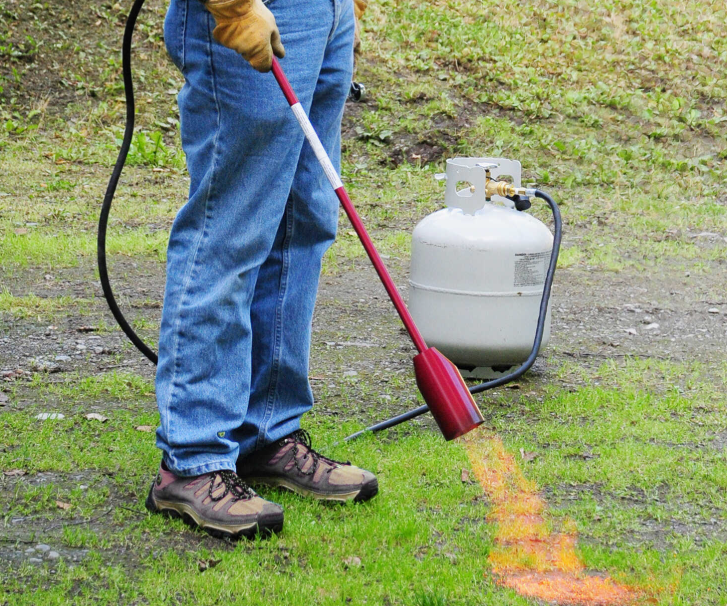
For three years I fought the same battle every spring. Weeds pushing up through every crack in my driveway, between my paving stones, along the edges of the concrete path that runs from the gate to my front door. I’d get on my knees with a hand tool, or spray everything with weed killer, and two weeks later I’d be right back where I started.
Then my neighbor pointed at a little propane torch she was running along her back patio and said, “Try this thing. It’s $35 at any hardware store.”
I haven’t bought weed killer since.
What a Flame Weeder Actually Does
A flame weeder — sometimes called a weed torch or propane torch weeder — doesn’t incinerate the weed. That’s a common misconception. You’re not trying to burn the plant to ash. What you’re actually doing is applying a brief burst of intense heat to the plant cells, causing them to rupture. The weed looks fine for a day or two, then turns brown and dies as the cell structure collapses.
This matters because it means you barely need to linger on each weed. Two to three seconds of direct flame is all it takes for most weeds. Running the torch over a crack is a sweep motion, not a blowtorch-held-in-place operation.
The plants you really want to destroy — the ones with deep tap roots like dandelions — will often need a second pass a week later. But shallow-rooted weeds between paving stones, the wiry grass that sprouts from sidewalk cracks, the clover spreading into your driveway gravel? One pass and they’re gone.
Why Pavers and Driveways Are the Perfect Use Case
This is where I think the flame weeder genuinely beats every other method.
Weed killer between pavers is messy, requires careful application to avoid killing surrounding lawn grass, and leaves chemical residue on a surface where children and pets walk barefoot. It also doesn’t work on weed seeds that germinate the following week — you’re treating the plant, not preventing the next one.
Pulling weeds from pavers by hand is miserable. The roots wedge between the stones and you rarely get the full root, meaning it regrows in two weeks.
The flame weeder has none of those problems. You simply sweep it along the joints, and you’re done in minutes. My driveway takes about eight minutes to do all the cracks and edges. My front path takes three minutes. The results last longer than hand-pulling because the heat also kills the seed bank in the soil immediately below the crack — so the next generation of weeds germinates more slowly.
What I Bought and What It Cost
I picked up a Bernzomatic TS8000 torch head for about $60 attached to a standard 1-lb propane canister. That’s on the higher end. Most people use a simple weed-burner torch with a longer wand and a 1-lb or 14-oz canister, which runs $25–40 at Home Depot, Lowe’s, or Amazon.
The propane canisters cost roughly $4–6 each at hardware stores. One canister gets me through three full sessions on my driveway, front path, and back patio perimeter. So about $1.50 per treatment.
Compare that to a bottle of concentrated weed killer at $12–18, which I was buying twice a spring.
Over one season I spent about $38 total (torch + two canisters). The torch will last years. Now it costs me ~$6/season in propane.
The Safety Part (Because People Always Ask)
Yes, you’re running a small open flame near your property. Here’s how to not do anything stupid:
- Never use near dry mulch, dead leaves, or anything flammable. This is the main risk. Clear debris before you start.
- Keep a bucket of water or a hose within reach the first few times until you’re comfortable.
- Don’t use during a drought ban or on very dry days in areas prone to fire risk — check local conditions.
- Paving stones and concrete are completely safe — the flame won’t damage them, won’t crack them, won’t stain them.
- Avoid using near wooden deck boards. Save the torch for stone, concrete, brick, and gravel.
I’ve used mine probably 30 times over two seasons without a single issue. The propane torch itself has a trigger lock for safety when you’re not actively squeezing it.
When It Works and When It Doesn’t
Best uses:
- Weeds and grass between pavers, flagstones, and bricks
- Driveway cracks
- Sidewalk edge weeds where mowing can’t reach
- Gravel driveway weed control
- Garden bed perimeters (around concrete edging, not near mulch)
Not ideal for:
- Broad lawn weeding — you’d damage surrounding grass
- Established perennial weeds with very deep roots (they’ll regrow; use pulling or herbicide for those)
- Areas with flammable materials nearby
My Honest Take After Two Seasons
The flame weeder is one of the few tools I’ve bought that actually changed how I manage my property rather than just adding another thing to the shed. I genuinely enjoy using it — there’s something satisfying about running the torch along a crack and watching a weed shrivel up over the next 48 hours.
More importantly, I stopped putting herbicide on surfaces where my kids play and my dog walks. That alone was worth the $35.
If you want to go deeper on eliminating unwanted grass from your lawn edges, our lawn weed control guide covers the full toolkit — from pre-emergents to mechanical removal. And if crabgrass between paved areas is your main enemy, how to get rid of crabgrass goes into the full lifecycle so you understand when to treat.
The flame weeder won’t solve every weed problem on your property. But for pavers, driveways, and cracks? It’s the best $35 I’ve spent on lawn care.